

Internal Communications Tips for When the World’s on Fire
For the people who have to hit send anyway.

It’s the second week of July and I’m momentarily confused on the internet.
On Instagram, I see the Toronto skyline. It looks like my favorite work of art. Then I see the next story. It’s a video of someone in a boat fleeing a wall of fire.
It looks unreal. It looks AI generated.
I google. It’s real.
Later that week, I see more pictures. Chicago. New York. Masks on my friends in Milwaukee.
The thing about air . . . you know, it’s everywhere. Smoke doesn’t respect borders.
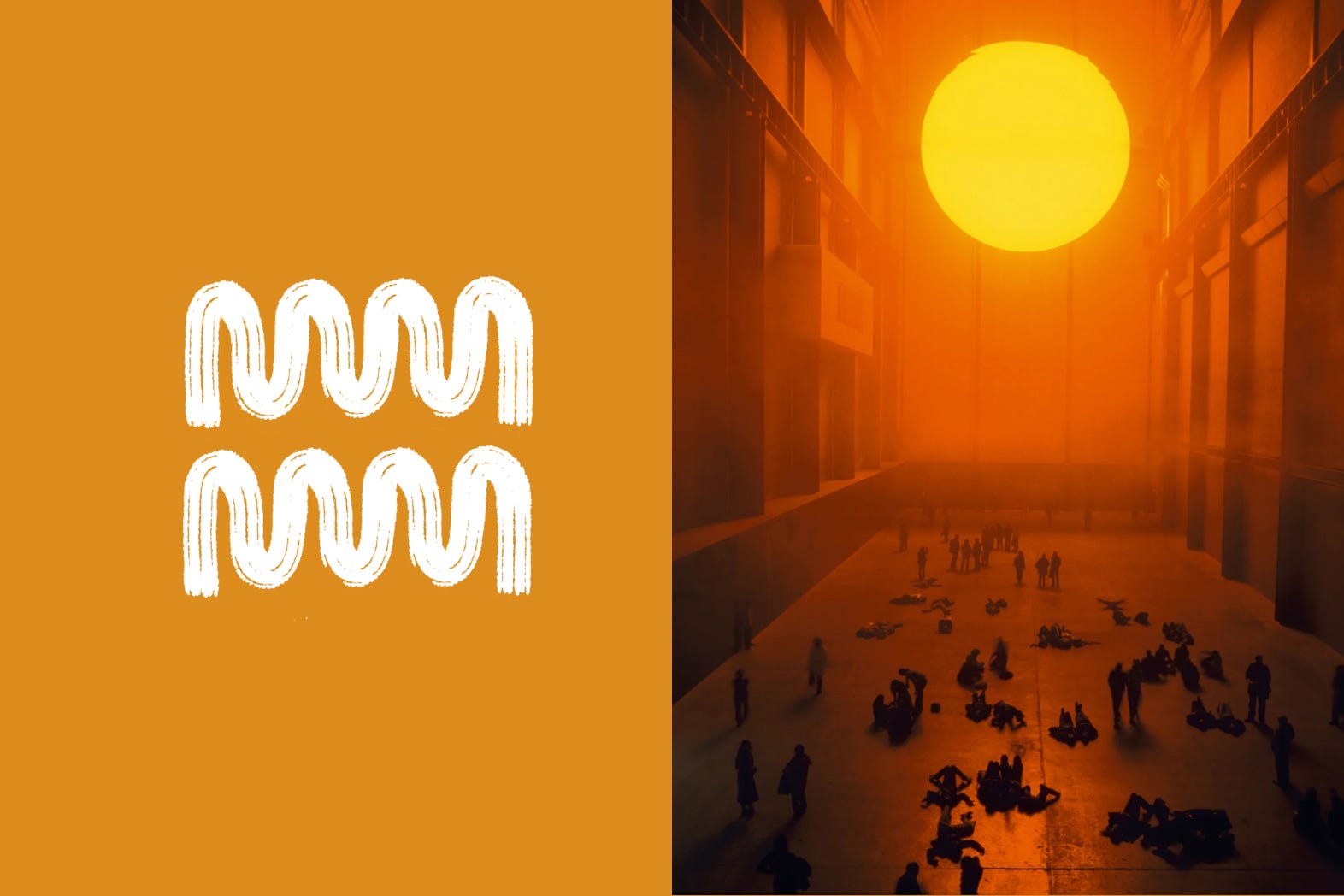
I think, I’ve seen this orange before.
Tell me:
What do you do when there’s a fire in your coworker’s proverbial backyard?
Do you insist on the 1:1? How about the team meeting?
When, exactly, do you bring up that the sky outside the window behind the person you see on camera every day looks, uh, a bit different?
Is it before or after you click to share your screen?
This wasn’t covered in the manager onboarding.
In This Issue
Where There’s Smoke · It’s Never Over · And Then the AQI Hits 300 · Both/And
Where There’s Smoke
At the risk of stating the obvious: Y’all, we have to talk about the environment.
There have been 41,377 fires in the U.S. so far this year, a 10-year high. There are close to 900 active fires in Canada as of writing.
And there is extreme heat everywhere. A thermal map of the U.S. right now looks like my dream Le Creuset dutch oven.
Japanese people even created a new term, kokushobi. It means “cruelly hot day.”
All of this has grave implications, from workplace safety to our own attention spans and even where we live and what we buy at the grocery store.
And all of it is stressful.
Consider that a nationwide analysis of heat and workplace injuries in the U.S. found injury risk rises with temperature across sectors.
It hits those who work outdoors the hardest — 20% of the U.S. workforce. Of those workers, 83.1% live in a state where more than a quarter of days have poor air quality. Nearly two-thirds live in a state with elevated heat wave risk.
Even if you work indoors, one study showed short-term exposure to PM2.5 — the kind of pollution that comes from wildfires — was associated with “reduced attention in adults within hours and days of exposure.”
That’s work, but there’s also where we live. In a recent Redfin survey of roughly 1,000 U.S. residents, one in six (16%) said they planned to move within the next year out of “concern for natural disasters or climate risks in my previous area, including heat, drought, flooding, fire, smoke or poor air quality.”
Financial stress plays a role, too. A U.S. Treasury analysis found that between 2018 and 2022, homeowners in the highest climate-risk ZIP codes paid about 82% more in premiums than those in the lowest, and had policies non-renewed at roughly 80% higher rates.
And things are only going to get more expensive. Research in Nature finds losses resulting from climate change amplify as they travel through global supply chains — heat in India impacts prices in the U.S. Think: What we’re seeing from the Iran war, but endless.
So, this is the future. A fire in Ontario becomes an attention problem in Milwaukee. A heat wave is a safety issue outdoors and a decision-making issue indoors if we’re working without AC. An insurance non-renewal turns into a retention problem 18 months later, when someone moves to somewhere safer.
And lest we forget about shareholder value (as if!), there’s that, too. The Lancet Countdown on Health and Climate Change found heat exposure caused 640 billion potential labor hours to be lost in 2024, with productivity losses equivalent to US $1.09 trillion worldwide.
We have to talk about the environment.
It’s Never Over
Back when I was in-house, I had a mantra I’d use with my team:
“I’m always going to assume you’re doing your best. I’m never going to assume you’re feeling your best.”
I can’t remember exactly how I arrived at these words, but they were pretty much there from day one, back when I joined in August 2020.
My life, like so many people’s lives during the pandemic, felt as though it was falling apart. I repeated these words as much for myself as for my direct reports.
Back then, I still thought there would be a day when it would all be over.
But as I wrote in Shifting Ground, the standard communications playbook “was designed for conditions that no longer exist: a discrete event, a defined timeline, and an eventual return to normal.”
I thought that mantra was for a bad year or two. Turns out it’s for forever.
Psychologists studying climate and mental health look at the acute hit of a disaster you live through, the chronic grind of slow-onset change like heat and drought, and the anticipatory distress of watching something arrive.
That third one is called anticipatory solastalgia — rivaling my favorite German word in its specificity.
It’s grief for a loss you see coming.
This is all important for communicators to think about, because stress that’s unpredictable and has no endpoint accumulates as allostatic load, which is the physiological toll of what it feels like to never fully relax.
Your body keeps waiting for the all-clear. There isn’t one.
As the modern landscape for employee communications ping-pongs between business as usual and crisis communications, neither can adequately meet this moment.
We build strategies to support an eventual return to normal, when what we need to be focused on is establishing a communication system that supports people in staying within their window of tolerance.
No one message will keep a person regulated. But by intentionally designing our communications to respect our people’s humanity, we can stop being one of the things that knocks them out of it.
And Then the AQI Hits 300
Think about your wellness program. Chances are it revolves around a calendar.
The step challenge is flagged in April, designed in May, produced in June, and launches in July. It’s got a hydration campaign, walking meetings, and a leaderboard — all of it is planned months out by people doing their genuine best.
And then the AQI hits 300.
The step challenge is still going. Why is the step challenge still going?
People don’t show up as blank slates. Right now, a lot of them are thinking about two things: heat and smoke.
We have to acknowledge when the air is orange.
Sometimes you acknowledge it by saying so. More often you acknowledge it through your decisions, through what you send, what you pause, and what you let people choose.
Pretending you don’t see the sky is itself a message.
The STEADY Framework I created is designed to support communicators in acknowledging what people are carrying — from the stress of working in extreme heat to going about daily life under a hazardous air warning.
There are six principles — Safety, Trust, Environment, Agency, Dialogue, and You — that map easily to communications strategy.
Here's what that looks like right now:
Stick to a schedule. Your regular communications should follow a cadence. Daily huddles or Slack bulletins at 8 a.m., the newsletter every other Monday at 9, monthly all-hands on the first Tuesday at 10. Pick a time, a day, and a channel, and commit. And this is the hill I’ll die on: tell people when they’ll hear from you next, regularly, because you know the schedule but nobody else does.
When a climate event happens, mobilize one-offs as necessary but also fold updates into the cadence people already trust, and name the next check-in. In today’s 8 a.m. bulletin:
The AQI is 300 and hazardous. We’ve shared some guidance below and with your managers. The next update will be at the same time tomorrow, sooner if it changes.
Read the room before you hit send. Think about what your audience is carrying. If smoke or dangerous heat is affecting part of your workforce, a chipper tone sends the wrong message. Can you try honesty?
Before we get into [topic]: we know some of you are dealing with wildfire smoke and dangerous heat right now. If that’s you, [what’s available].
Then, audit what’s already scheduled against what’s actually happening. Somewhere in your org, an automated workflow is about to send something written weeks ago by someone who couldn’t have known about today. Back to the step challenge — pause it and send this message instead:
Air quality is hazardous today. Stay inside where you can, keep windows closed if possible. If your role means you’re outside, [the plan and who to talk to]. We’ve paused the step challenge until the air clears.
Make information findable before people need it. Benefits, PTO, leave. Who to talk to when X happens. What to do in the event of Y. It should be linked and easy to find: breadcrumbs at the top of the intranet, a footer in your emails, a pin at the top of the relevant Slack channel. EAP should not be buried three clicks deep. And if you have an AI assistant, get that trained and tested ASAP. When a hard week hits, you can pin one line to the top of every channel people check:
“Wildfire smoke resources: air-quality policy, work-from-home request, and EAP → [link].”
If you’re a manager, repeat yourself. You cannot remind people too often about genuinely useful information. Say it in the huddle, again in the 1:1, a third time at the end of the week. Plain language beats a paragraph of policy every time:
If the AQI is over 150, you don’t need to come in. Ping me and work from home.
Make experts available. When people have questions, tell them exactly who to ask, then have that person show up. People trust a name and a face they can put a question to more than they trust a link. During a wildfire, give your facilities lead 10 minutes in the all-hands to take live questions:
Join Tuesday’s all-hands: [Name] from Facilities is taking your questions live on air quality — what our building’s filtration actually does, whether to keep windows shut, and what we’re doing about it this week. Drop questions ahead of time → [link].
Meet people where they actually are. Under stress, people read, watch, and listen differently, so send three-line messages in Slack and the full one in your next scheduled email or on the Intranet. If you have a live event, follow up with the recording within 24 hours1. Put safety steps in plain words where deskless workers actually are: the morning huddle, a sign by the time clock, a text. For an outdoor crew in a heat wave, a 6 a.m. text:
“There is a heat advisory today, with a high of 104. Water and shade will be available onsite. Your manager will review safety measures for heatstroke.”
This might cost money depending on your tech stack, but for a lot of teams, the only thing it requires is deciding that the conditions your people are working in are part of the work.
Both/And
It’s the second week of July, and I’m on a walk through Forest Park with Kelli, one of my best friends and a former Portland resident.
It’s glorious. Fecund and green everywhere.
“I heard you didn’t get any snow this year,” she says.
“Gonna get some fires this summer,” she continues, as matter-of-factly as you’d expect from someone who was here in 2020.
She asks if I own masks. I make a mental note to pick some up.
It’s the second week of July, the world is on fire, and someone in your organization is wondering when you’re going to mention it.
Currently
Building: My presentation for next week’s ALI Employee Experience Virtual Certificate Series. And my packing list, because I’ll be delivering it from the Oregon Coast.
Enjoying: Being silly. Last weekend I told my 11-year-old godson about the first time I saw the hamster dance in 1999 and he demanded I check to see if the website still exists. I did, it does (a version of it at least, anyway), and together we laughed for an hour. My brain felt as untroubled as a jellyfish.
Listening: “OnlyFantasy,” an investigative podcast about OnlyFans. Season-long podcasts aren’t really my thing, but after Margo’s Got Money Troubles I was curious. I’m enjoying it.
Reading: Finished Lily King’s Writers & Lovers and pretty much want to devote the rest of my days to writing half as well as she does. There was an essay tacked on at the end of the book called “Worms, Eggs, Sperm, and Other Thoughts on Writing.” I want to feel her passion for her craft imprinted on my soul. I don’t know how I’m going to want to read any other author for a long time, so I guess I’ll look for bookstores at the beach to find more of her work.
Watching: Nothing. It’s blazing hot and I only have AC in my bedroom, where there isn’t a TV. There’s a reason I’m reading so much.
Wondering: How it’s going to feel to paddleboard for the first time in a year.

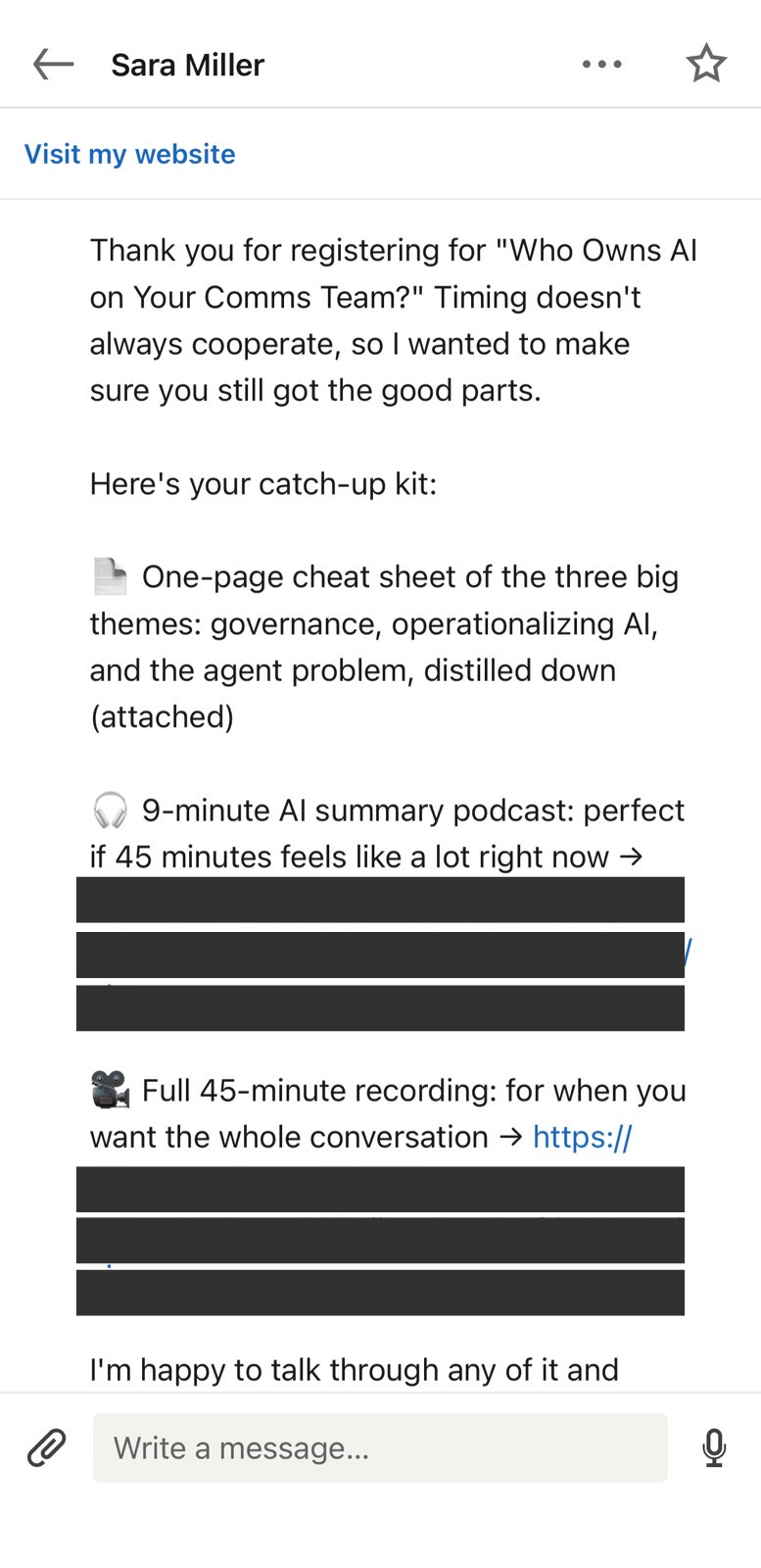
Look at this fabulous example from AI strategist and speaker Sara Miller. A one-page cheat sheet, a 9-minute summary, and the full recording. Note the language — “if 45 minutes feels like a lot right now.” This is excellent. You could crib this for an all-hands follow up and/or provide to managers as a template. No notes.
What a great article Ellen! Although I knew the concept from my work with the Rosalynn Carter Institute for Caregivers (every unpaid caregiver needs to check them out), I have never heard the term anticipatory solastalgia. It turns out that is an action I've taken often but didn't know what it was called.
After my mom died, losing my dad was an overwhelming thought especially when he was diagnosed with cancer very soon after. Unbeknownst to me, I started employing the technique, we called it pre grieving, of walking myself through the worst day of my life. Most people called it worrying but it was more, it was how I thought I would react and how I would manage the logistics of getting from the Virginia peninsula to Manitoba at a moment's notice.
So on one hand, it can be stressful and detrimental but on the other it can prepare you to handle that which you think you never can.
It is sooo good to find an internal comms peer on Substack. Nice to meet you Ellen!